
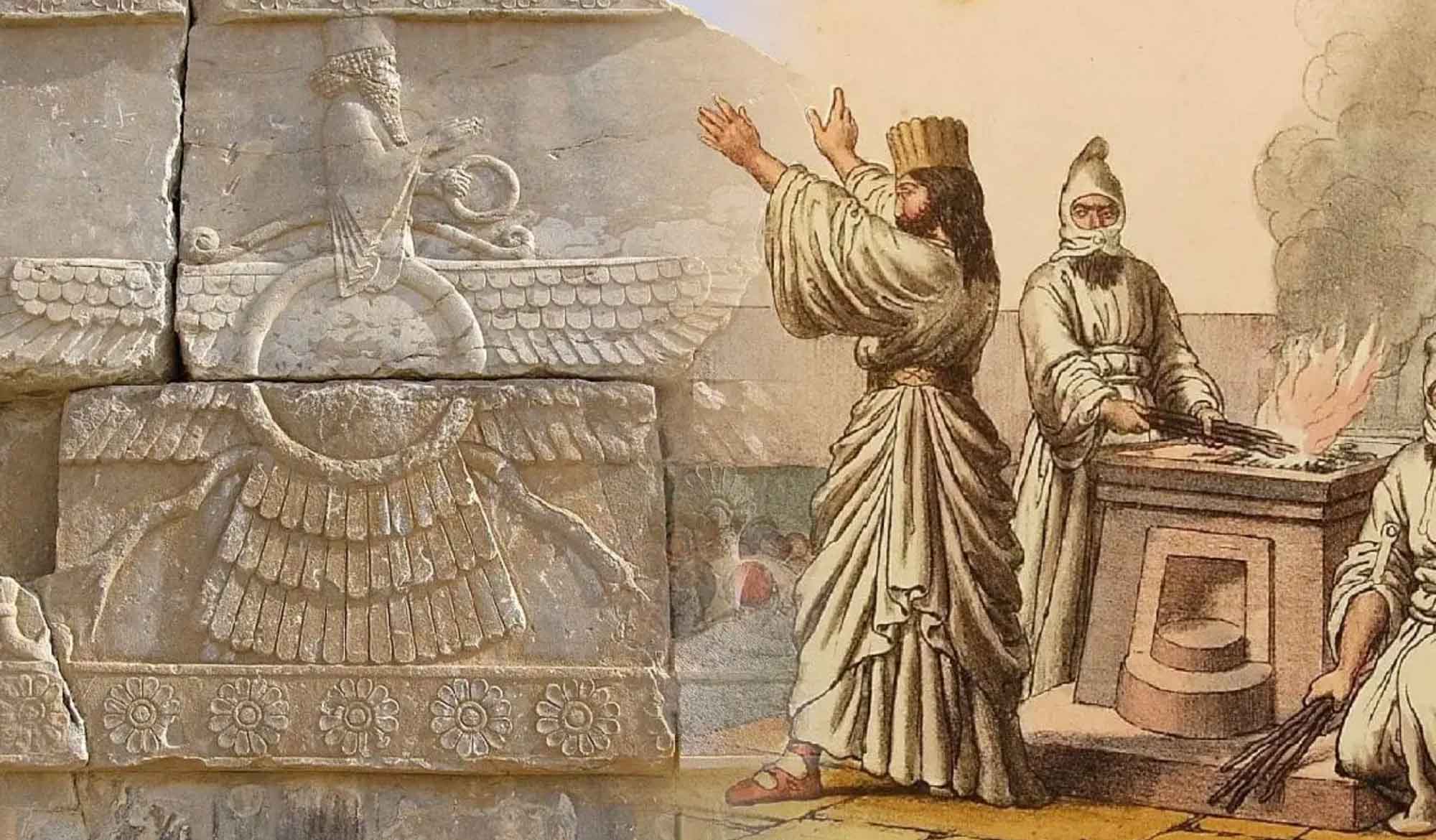
Now that the news cycle is back to speaking about war in Iran and the rise of Persian identity, there is a little known fact that I meant to bring up in the past but forgot to. Most everyone is aware that the country name “Iran” is based on the Sanskrit concept of Aryan, the “noble people”. Lord Krishna Himself mentions the word in Bhagavad Gita when he tells Arjuna, anārya-juṣṭam asvargyam akīrti-karam arjuna, “This conduct is unbefitting of the noble (arya), it does not lead to heaven, and it brings disgrace”.
The arya concept is mentioned in the oldest Vedic scriptures such as the Rig Veda, and is also present throughout the Puranas, Itihasas, etc. Of course Lord Krishna is not saying this conduct is unbefitting the “Iranians”. Arya is a concept of civilized humanity, not a particular country, and the word was later borrowed by those cultures centered around Iran to declare themselves as the “civilized people”. The word and concept is Sanskrit, and the Iranians borrowed from that ancient Sanskrit culture (not the other way around) to name their country.
This part of the story is more or less well known and nothing new, but my intention was to focus on another term of identity used by the people of Iran, a connection more obscure that “official” versions will teach wrongly. Iranians are very proud of being Persian, which is completely distinct from their Arab neighbors, but few people are aware the word “Persia” is not “Persian”, or whatever local nomenclature one wants to give. Neither is it Greek, as modern sources of “knowledge” will make you believe.
Persia is a Sanskrit word, and we can definitively prove it because the early Iranian version of the word (Parsa) does not have the meaning built into the word as it does in Sanskrit. They simply say it refers to a region on a map with no inherent meaning. This is one of the reasons we can conclusively know the Aryan Invasion Theory is false. In nearly every case where the two cultures have similar phonetics, the Sanskrit versions contain rules by which the words are formed and create inherent meanings, where as in Avestan the words are simply borrowed with static meanings.
Persia was originally called in sanskrit by several related terms such as “Parshu”, “Parshva”, “Parshava” and “Parasika” (from which the modern term Parsi is derived). These have several meanings which we will go through. First they are based on the Sanskrit word “parshu”, which means the side, flank, or the cutoff division between one area and the next as distinct from the central core. This implied a distant frontier as opposed to the central core of the Vedic empire. The area of modern Iran was on the outskirts of the kingdoms of Bharata, thus it was referred to as Parshva, the side frontier separating India from the outer world of uncivilized areas. The name Parasika likewise means “the distant people”, from the word para meaning “distant”, “beyond” or “foreign”. (Ref. Mahabharata 6.10.51: tilakāḥ pārasīkāś ca madhumantaḥ prakutsakāḥ)
We should note if the Aryan Invasion Theory was true, they would not name themselves as secondary non-core characters in the world. They did not invade India and bring their culture to central India, rather they were on the outskirts of the Vedic empire, and their names signified this clearly.
The second meaning of Parshu is it was the name of a specific king which we will go into detail later, who is referenced in the Rig Veda. Those areas ruled by King Parshu were called the province of Parshva, and they are mentioned in several places such as the Mahabharata in regards to kingdoms of Bharata. (Ref. Mahabharata 6.10.54: vanāyavo daśā pārśvā romāṇaḥ kuśa bindavaḥ. Note that they are mentioned along side the distant Romans.)
The third meaning of Parshu is a specific battle weapon, a curved sword, slightly different from the more famous battle axe (parashu) which is phonetically similar. The logic behind the naming was that parshu in Rig Vedic language refered to the side, or to the ribs or rib bone, which is in a curving bent pattern. Therefore a curved blade was given the same name, parshu. Later in Puranic style writing, language had different developments and rules, and the battle axe was called as parashu, with the phonetic adjustment of the inclusion of an additional vowel. Thus there are two weapons that are phonetically very similar and in fact based on the same roots, but which have minor differences.
The Rig Veda (8.6.46) speaks of King Parshu (who is named after the curved bladed weapon, being skilled in its use):
śatam ahaṃ tirindire sahasram parśāv ā dade
“I received a hundred gifts from Tirindira, and a thousand from Parśu.”
In Ashtadhyayi (5.3.117) Panini has given a sutra related to this specific tribe:
parśvādi-yaudheyādibhyām aṇ-añau
“The suffixes aṇ and añ are added respectively to the list of words beginning with Parśu and the list beginning with Yaudheya.”
Here Panini is explaining a rule for forming derivative words (taddhita), such as related to, descended from, belonging to, etc. By this specific rule, those belonging to the Parshu tribe are referred to as “Pārśava”.
Most of us will be familiar with similar grammatical examples, in the case of the Pandavas descending from King Pandu, the Yadavas descending from King Yadu, the Raghavas descending from King Raghu, the Kauravas descending from King Kuru, etc. Thus someone or a group of people who descended from the dynasty of a King named Parshu, would be called as Parshava.
In sutra (5.3.114) Panini has given a broader heading for this topic as “ayudhajivi saṅgha”, those groups who live by weapons.
In the famous commentary to Ashtadhyayi known as Kashikavritti, the explanation of sutra 5.3.117 further makes it clear that Parshu and Parshava are a warrior tribe who are expert in using weapons:
āyudhajīvisaṅghavācibhyaḥ parśvādibhyaḥ
“Those Parshus and similar groups who denote a collective living by weapons…”
Thus as per the Ashtadhyayi and its commentaries, there was a warrior tribe who fought with specific weapons, called as Parshu, and a group of people descended from this tribe would be called as Parshava.
I would like to conclude that the word Persia is originally neither a Greek word nor an Iranian word, but it is without a doubt an ancient Sanskrit word, that is referenced in the Rig Veda, the Puranas, the Mahabharata, and even in the Ashtadhyayi of Panini. There are three distinctive meanings to this word as shown above, which are still understood through the rules of Sanskrit grammar showing that this has originated in ancient India, and not in Iran nor in Greece, where they hold no inherent meaning for the word other than as a specific region.

Every cow and calf at our sanctuary has a story of rescue, healing, and hope. Your generous support provides them with food, shelter, medical care, and a lifetime of protection. Together, we can give these sacred animals the love and safety they deserve.




बेहतरीन एवं आवश्यक जानकारी प्रदान की है अपने बहुत साधुवाद के पात्र हैं यह सभी को जानना चाहिए।
[Google translate: “You have provided excellent and essential information. You truly deserve appreciation. Everyone should know this.”]
As born Parsi Zoroastrians, we are very grateful to India for having given us religious sanctuary 1300 years ago. Regarding your article, let us be reminded of Lokmanya Tilak’s masterful work, “The Artcic Home in the Vedas”, in which he studied the Sanskrit Vedas and Zoroastrian Avestan Vendidad and concluded that the ancient Aryan people lived in the Artic region and composed the Vedas there, he came to this conclusion due to certain stars mentioned in the Vedas which were only visible in the Artic, and the length of the Usha dawn ceremony, which could only happen in the Artic. Vedic Sanskrit and Avestan are sister languages with many similarities such as the words yagna and yasna, rita and ereta, ahura and asura etc. The Avestan Vendidad speaks of the migration of the Aryan ancestors from the ancient homeland Airyanam Vaejo, the Seedland of the Aryans, because the ancient warm homeland was attacked by severe winter and the ground became hard as stone as mentioned in the scripture., meaning the Ice age started 10,000 years ago in the Artic, and the scripture says the people moved to the south and the southwest, into the lands of Iran and then India, and also Europe. Tilak studied both the Vedas and the Vendidad. It was not an invasion, but a migration, in those days people used to migrate to different lands, there were no borders, the whole world was one. The King in the ancient Aryan homeland was Yama Kshaeta (King) in Avestan, who was later called Jam-shed (from which the word Shah derives) in Iran, and Yama Raj (King) in India later on. And also, the word Hindu is derived from the Avestan Vendidad which mentions the Hapta Hindhu or the land of 7 rivers as one of the good lands created by Ahura Mazda, that is the same as Sapta Sindhu in Sanskrit, the land of 7 rivers. So Hindu initially actually meant everyone who lived in the land. Ahuras are divine beings in Avestan, and Asuras were initially divine beings in the Vedas, until the word took on a different meaning in later Sanskrit scripture.