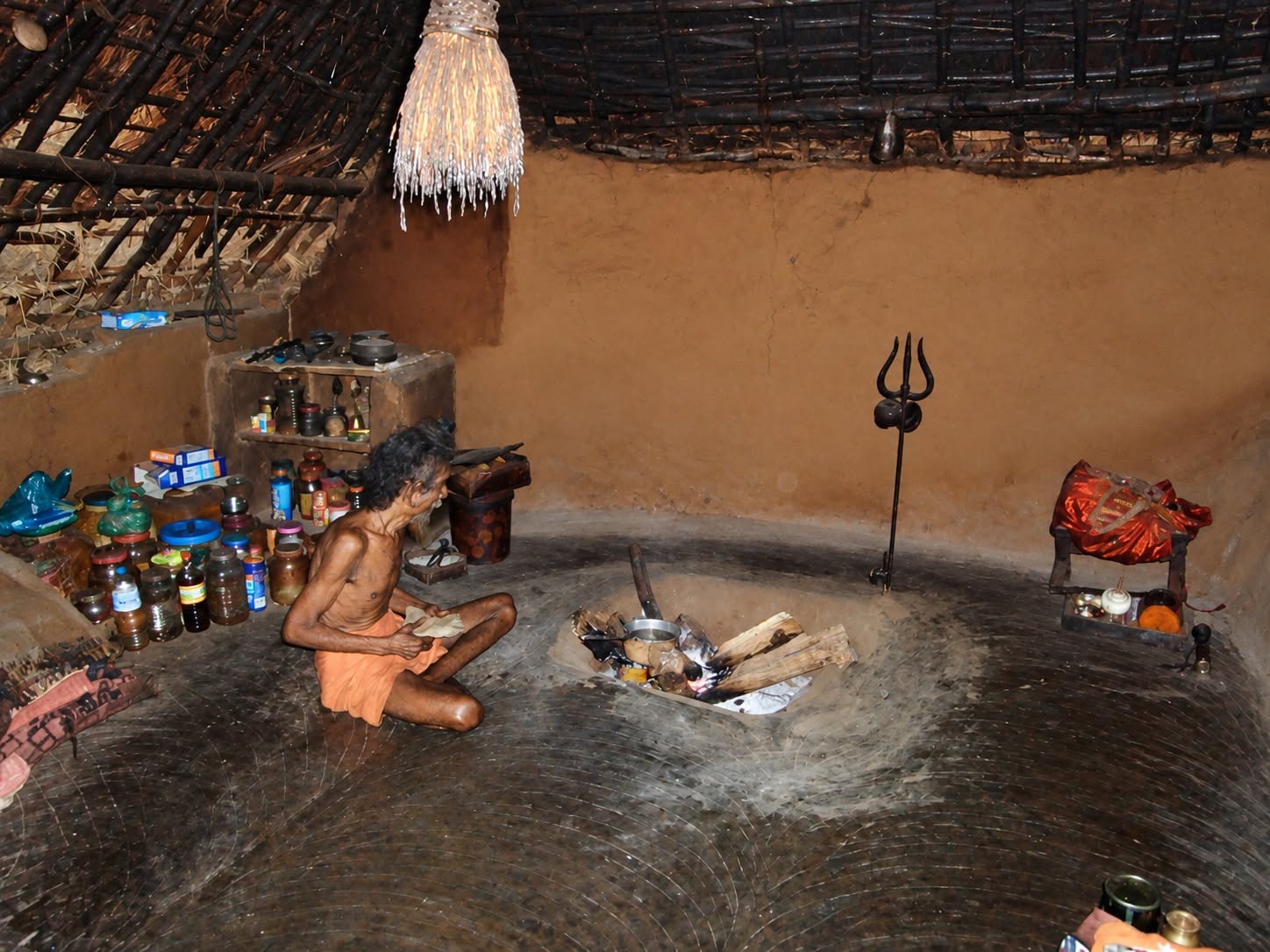
Chakratirtha Baba tending the dhuni inside his mud hut in the Salandi Reserve Forest. This photo was taken on August 31, 2012, when he was 91 years old.
You can see he is boiling a pot of water on the dhuni. That is his tea making pot. He had another round pot which he would use for cooking kichadi every day for the shiva temple naivedyam, which was also cooked on the dhuni fire. Baba would often keep a pot of water heating on the dhuni throughout the day, especially during the winter months when there was more need for hot water.
For sadhus a dhuni is a yajna kunda where they daily worship Bhagavan in the form of fire through sacrificial oblations three times a day. But unlike a Vedic yajna kunda, the dhuni also sustains their physical life in practical ways, allowing them to cook, heat water, and receive warmth in the winter. The rules for a sadhu dealing with his dhuni are not as restrictive as a Vedic yajna, though ultimately both serve the same purpose.
Hanging from the ceiling is a bundle of rice paddy, kept to invoke auspiciousness. On the right side, wrapped in a red cloth, is a mridanga. Baba would hold kirtan every single day, especially in the evening after sunset. Mostly he would chant Hare Krishna maha mantra, as well as some Odia Jagannatha bhajans, and guru bhajans written by Bhima Bhoi (Mahima Alekha sampradaya). As a child his father had donated him to the Mahima Alekha sampradaya at Joranda, though later he took initiation from another Hindu saint named Ramananda Saraswati, who’s samadhi is located in Jharkhand near Jamshedpur on the border with Odisha.
In the right corner of the yajna kunda is a trishula with a damaru hand drum hanging on it, as well as a small parashu (axe) at its base. I once asked him about the parashu in his yajna kunda and what its significance was. He replied, “no one will be able to understand these things.”
On the left is baba’s simple blanket rolled up in the corner, and the jars of cooking ingredients which baba used every day to cook prasadam for distributing to visitors.
The floor of the hut, was made from mud, but it was hard like cement and polished like marble. This was because every day three or four times Baba would mop the floor with water and cow dung. After years and years of mopping the mud floor, it had tranformed into a hard and shiny material. You can see the difference between the mud wall and the mud floor, though both were made from the same materials.
Question from the Comments: Are dhunis primarily a Shaivite thing or do Vaishnava sadhus also utilize them?
Many of the wandering sadhus who live in North India keep dhunis, both Shaivites and Vaishnavas, though each one sees it as their own particular deity (Shiva or Vishnu). Vaishnava’s who keep dhuni are called by the title “Vairagi” in the sadhu community. As the Shaivites have Naga Babas, the Vaishnavas have Vairagis.
The agni represents para brahma, in line with the following statement of Bhagavad Gita (4.24):
brahmārpaṇaṁ brahma havir
brahmāgnau brahmaṇā hutam
“The offering is Brahman, the oblation is Brahman, the one offering is Brahman, and the fire into which the oblation is offered is Brahman.”
The dhuni fire is a personal deity of the sadhus which they can worship and offer oblations to without the need for an elaborate temple. They can manifest Him anywhere for worship simply by lighting a fire. As they wander from tirtha to tirtha, at sunset they can sit under a tree and light their dhuni. In that fire they will complete their daily worship as well as cook their food. All food that they prepare in that fire will first be offered back into that same fire before eating.
Question from the Comments: Do they have and use matches for creating fire?
Baba uses matches for things like incense, but the dhuni fire burns forever and never goes out. It has been burning for more than 50 years. That is their sadhana to maintain the fire without interruption. Even during the Odisha super cyclone of 1999, where 10,000 people died, the water level rose up to touching the hut, but did not come inside. The fire continued to burn under Baba’s care, with no food, and surrounded by an ocean of flooding. Baba’s hut is perhaps 15 or 20 feet above the adjacent river level, but during that cyclone the water had reached to touch his hut.
In the old days for yajnas people would not use matches for lighting the yajna fire. They would use wood and rope to create fire through friction. Baba used to be very experienced in creating that type of fire, and he would be called for lighting the fire in yajnas and pujas in other areas during religious festivals. Today some people still follow this tradition but most now use matches for simplicity.
Every cow and calf at our sanctuary has a story of rescue, healing, and hope. Your generous support provides them with food, shelter, medical care, and a lifetime of protection. Together, we can give these sacred animals the love and safety they deserve.



0 Comments