

As most will know, Hindu originally referred to a region, and was derived from the name of the river Sindhu. In ancient Iranian languages, the sanskrit ‘s’ was often converted to ‘h’, so the Sindhu region became known as Hindu. This Iranian form of the word was then transmitted to Hebrew, where it became Hodu, and was used in the book of Esther in two places to refer to the region of India.
“This is what happened during the time of Ahaseurus (King Kshayarsha/Xerxes), who ruled over 127 provinces stretching from India (Hodu) to Ethiopia (Kush).” – The Bible, Esther 1.1
Some may say the word is spelled differently and therefore not the same word as “Hindu”, but I would argue that mispronunciations of a word are still the same word. For example in English they have the word “juggernaut”, which is the same word as the Sanskrit Jagannatha. Just because it is mispronounced and corrupted, does not make it a separate word. It’s the same word, misunderstood and mispronounced. Likewise, the Hebrew word Hodu is just a mispronunciation and corruption of the older persian word Hindu which referred to the region of India.

Queen Esther approaches the Persian king Ahasuerus.
Continuing along this same line of thought, let us look at another interesting name in the Bible with Sanskrit roots, the first wife of King Ahaseurus (Xerxes/Kshayarsha). In Hebrew her name is recorded as Vashti, but it is not a Hebrew word, it is an Avestan name copied into Hebrew. The original Avestan name was “Vahishta”, which meant “the most excellent”. That word is directly borrowed from Sanskrit. The name “Vasishtha” in Sanskrit also means “the most excellent, the best, the richest”. As is common, when words were borrowed from Sanskrit to Avestan the ‘s’ was converted to ‘h’ forming “Vahishta”. Later when that name was passed on to Hebrew it became corrupted as “Vashti”.
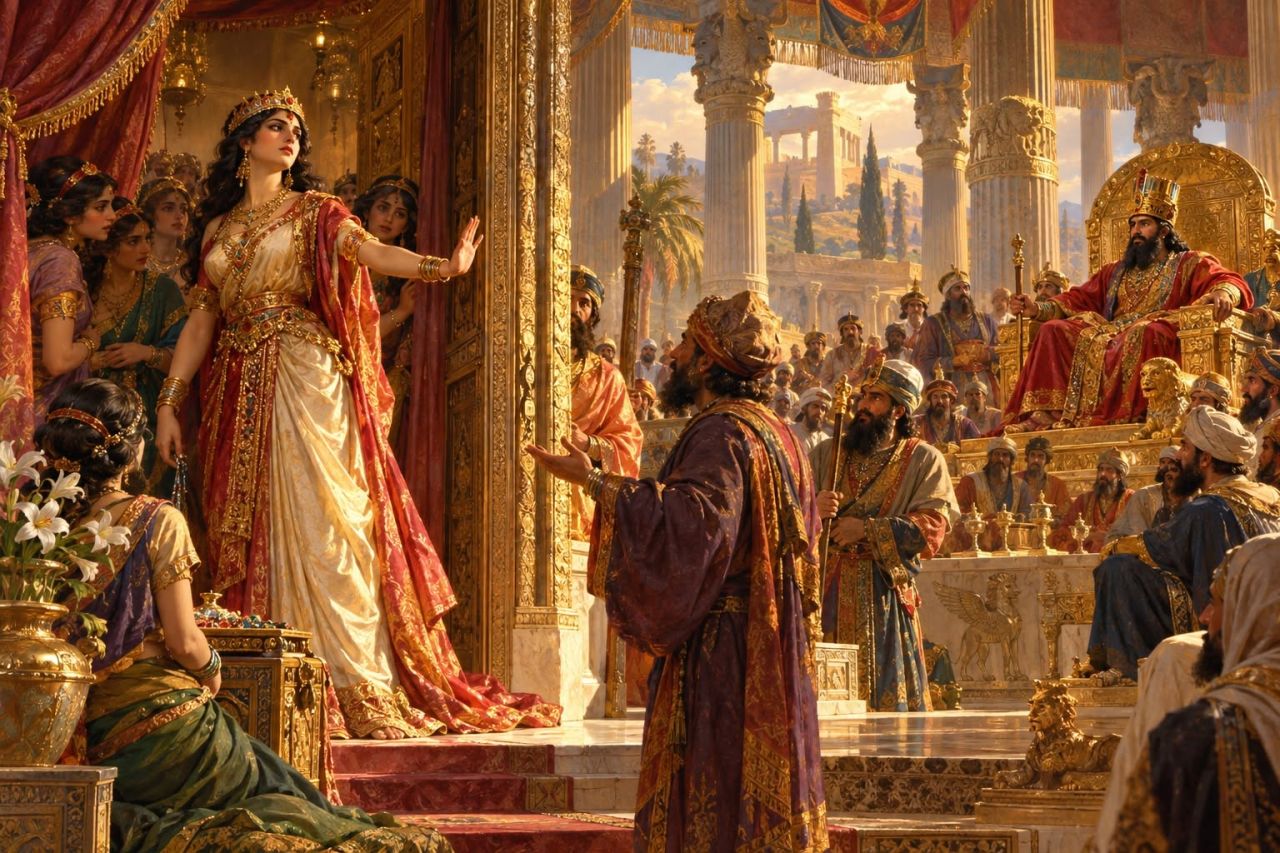
Queen Vashti refuses the order of the king.
We should keep in mind, Persians having Sanskrit related names did not mean they were “Vedic” Hindus. They followed “Zoroastrianism”, which was an inverted mirror reflection of the Vedic religion. In Zoroastrianism the Asuras were the good beings, and the Devas were the demonic beings. Thus even though most of the concepts matched, they followed an inverted system where asuras were the divinities.
Queen Vashti was banished for refusing to appear naked in front of an assembly as ordered by the King. As you can see from this, the king followed an asuric lifestyle, an inversion of the Vedic religion.
“But the queen Vashti refused to come at the king’s command by his chamberlains: therefore was the king very wroth, and his anger burned in him.” – The Bible, Esther 1.12
“If it please the king, let a royal command go forth from him, and let it be written among the laws of the Persians and the Medes, that it be not altered, That Vashti come no more before king Ahasuerus; and let the king give her royal estate unto another that is better than she.” – The Bible, Esther 1.19

Every cow and calf at our sanctuary has a story of rescue, healing, and hope. Your generous support provides them with food, shelter, medical care, and a lifetime of protection. Together, we can give these sacred animals the love and safety they deserve.



0 Comments